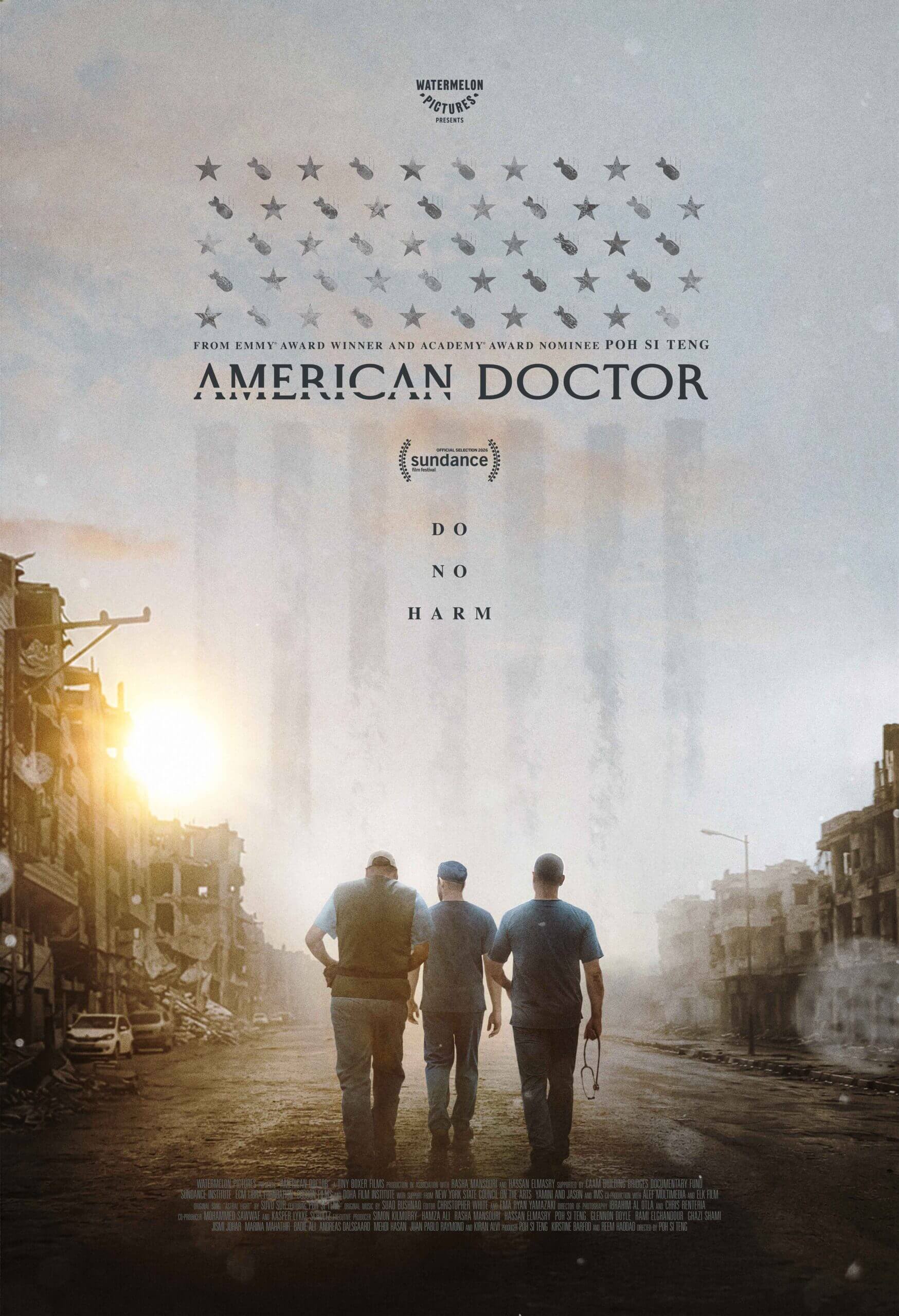
American Doctor (2026)
Director: Poh Si Teng
Genre: Documentary
Run Time: 93 minutes
Synopsis:
Three American physicians, one Palestinian, one Jewish, and one Zoroastrian, answer the same call to heal in the hospitals of Gaza. Back home, they refuse to stay silent, carrying their fight from the front lines to Congress.
“Well, that lacked any nuance.”
That’s what the elderly woman sitting behind me said at the end of American Doctor. Everyone else sat in silence, so I heard every word. Watching her shuffle out with the still-silent crowd, huffing under her breath, I wondered whether we had seen the same film.
American Doctor has no interest in debate. Poh Si Teng does not set up two sides and hold the scales between them. That is a deliberate choice and Teng has never hidden why she made it.
Born in Malaysia, Teng trained as a journalist, shot video for The New York Times, and ran the documentary series Witness at Al Jazeera English before taking an executive editorial job at Disney-owned ABC News Studios. When the war began, she was, by her own account, sad all the time. What finally moved her was the killing of fellow journalists, many of them close friends. She reached a point where, as she puts it, “I didn’t have any more words.”
So Teng quit ABC, sinking $150,000 of savings into her feature debut. The only question was where to point the lens. She found her inspiration in three American doctors.
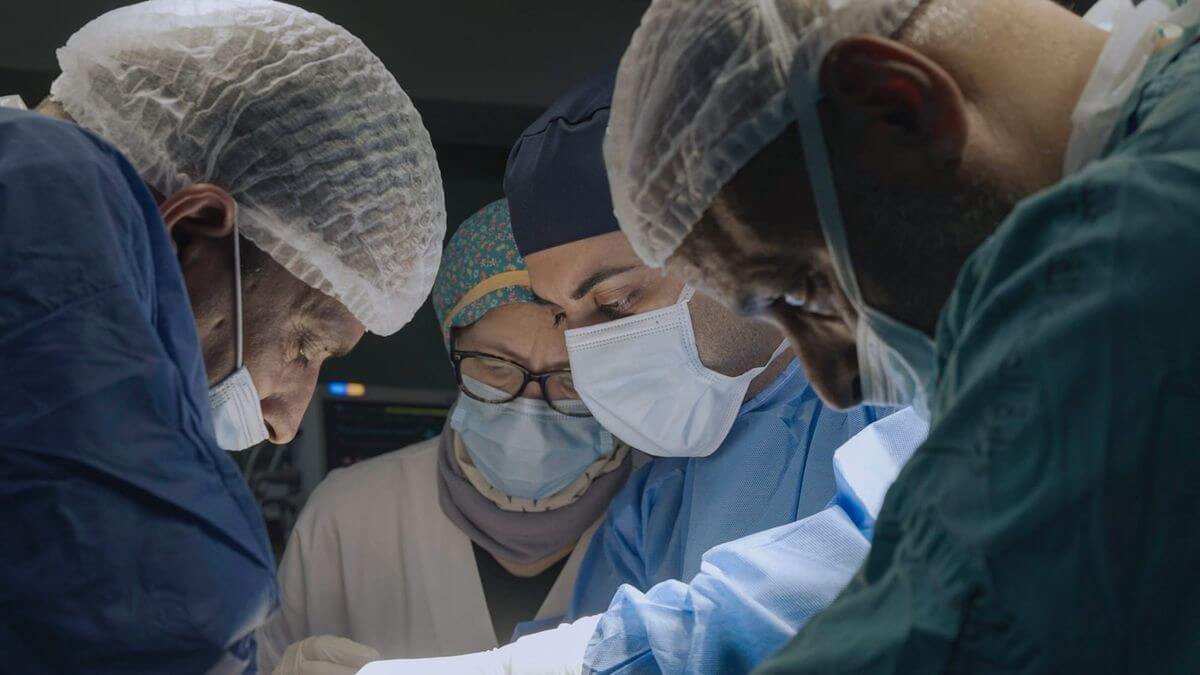
Mark Perlmutter is a Jewish American orthopedic surgeon from North Carolina. Thaer Ahmad is a Palestinian American emergency physician from Chicago. Feroze Sidhwa is a Zoroastrian trauma surgeon from California. Rather than dividing them, their differences complement one another. Scenes of their camaraderie elicit genuine laughs. Together, these men handle horrors beyond imagination.
Amputations without anesthesia. Pregnant women with shattered pelvises, their unborn babies cut in two. Child after child, many with a bullet in their brain or heart, day after day. All this and more while war rages around them.
Teng shoots all of it in an unadorned vérité style. No narrator swoops in to reassure you. It does not shy from blood or bone. The opening scene alone shows a photo of dead toddlers, neatly laid out in a row. When Teng mentions that she may censor the image to protect the children’s dignity, Perlmutter advises her against doing so.
“You’re not dignifying them unless you let their memory, their bodies tell the story of this trauma, of this genocide. You’re not doing them a service by not showing that,” he says, “Israel took away their dignity.”
Teng has said she opens on that image because she wanted to shake the people closest to her, including her own friends and family. By the time she started filming, she had run out of the language to reach them. These three doctors, she says, gave her that language back.
Occasionally, you will see videos that the doctors shot during their time in Gaza. Many of these clips show rare bits of joy, but some are haunting in hindsight. In one video, Perlmutter introduces his Palestinian medical team – even in the midst of Hell, they smile at the camera. Still, the wholesomeness of the moment has a harrowing undertone: how many of those team members are still alive today?
Here is the part the film will not let you look away from – the part that stays with you, whatever your affiliation.
The United States sends Israel roughly $3.8 billion in military aid every year. Since the war began in October 2023, one academic study puts the total military assistance at more than $21 billion. That money buys missiles, guns, bulldozers, and the healthcare that so many Americans go without.
It is paid for out of American taxes. It is paid for by you. The missile that brings a stairwell down on a family in Gaza may well have been bought with dollars withheld from your last paycheck.
This is the uncomfortable center of the film, and by Teng’s own account, it is why she picked up a camera at all. In her director’s statement she refuses the usual distance: this is not only Israel’s war on Gaza, she writes, but America’s war, fought with billions of dollars of American weapons. American Doctor is her way of honoring those who have been lost and fighting for the living, of bearing witness and refusing to look away. These are American doctors, holding American passports, digging American shrapnel out of Palestinian children. The citizens of a self-professed democracy, she argues, cannot wash their hands of what their taxes fund.
The film makes that circuit explicit in a single cut. Near the end, it runs a news soundbite of Donald Trump assuring the country that Israel has used the weapons America gave it well. It then shows you those weapons at work. The editing does the argument for you: the people in charge know – it’s just that they don’t care.
By the World Health Organization’s count, on the order of 94 percent of Gaza’s hospitals have been damaged or destroyed. Monitors including Physicians for Human Rights Israel put the number of health workers killed above 1,500, with hundreds more jailed in Israel without charge. Researchers estimate that life expectancy in Gaza has fallen from about 75 years to roughly 40. The territory’s only dedicated cancer hospital has been put out of service, cutting thousands of patients off from treatment.
You cannot kill a region’s doctors and pretend you have killed only the doctors. Kill the one pediatric cardiologist and every child with a failing heart is doomed. Kill the one neonatologist and the premature babies who needed him have no one.
Sometimes the targeting is precise enough to leave a signature. Perlmutter, a hand surgeon himself, has testified about a Palestinian colleague taken from the operating table and into Israeli detention. While in custody, they broke his fingers – every single one, and not by accident. All to ensure those hands would never operate again.
Sidhwa worked beside a young Gazan surgeon on the March day in 2025 when Israel shattered a ceasefire from the air, killing more than four hundred people in a matter of minutes. The man was two years out of his training, seven months of it spent in an Israeli prison. About forty-five minutes into the carnage, someone carried in the body of his father-in-law. He prayed over it, returned to the operating table for another sixteen hours, then walked out to pray at the grave and came back to work through the night.
Maybe you have heard of Dr. Hussam Abu Safiya.
He is a pediatrician. He ran Kamal Adwan Hospital, the last major hospital still standing in northern Gaza, and he refused to leave it even as it was bombed around him, even after an Israeli strike killed his own son. He became the public voice of Gaza’s collapsing medical system, giving interviews to the world’s cameras while the ceiling shook.
In December 2024, Israeli forces raided the hospital and took him. He has been held ever since, without charge and without trial, under a law that lets Israel detain people from Gaza indefinitely. This summer, Israel’s Supreme Court rejected his appeal and upheld his detention into at least October. His lawyers say he has been beaten until he is barely recognizable, held in prolonged solitary confinement, and denied medical care. A United Nations commission has ruled the whole thing arbitrary and unlawful, yet his life is still in danger this very second.
Dr. Hussam Abu Safiya helped children until the day the IDF came for him. Now the children of northern Gaza do not have him, and at this rate, never will again.
Which brings us back to that elderly woman, and to nuance.
The nuance in American Doctor was never going to be geopolitical. It is human, and it sits right there in the casting that real life provided. A Jewish American surgeon flying into Gaza to save Palestinian children complicates whatever notion you carried into the theater with you.
The people sounding the alarm are not who you would expect, if this were really a story with two clean sides. Sidhwa has made his case alongside Israeli physicians. More than 600 Israeli health workers have put their names to a letter of protest. Perlmutter is Jewish. They call what they are doing medical ethics, not politics: the old refusal to stand by while a neighbor bleeds.
Ahmad’s Palestinian heritage made his own entry into Gaza harder than his colleagues’, even though his American credentials are identical to theirs. Israeli authorities turned him back at the crossing five separate times: the same passport, the same training, a different reception. The film documents every attempt.
Teng has called Ahmad the north star of the film, its heart, and the rejection lands as hard as it does partly because of how much she was pulling for him. She has admitted she was quietly rooting for him to get in; when Perlmutter and Sidhwa were let through in March 2025 and Ahmad was turned away, she was crushed for him, and had nothing to say that would help. Afterward he went silent, and stopped answering her calls and texts. She flew from New York to Chicago, told him only that she was there, and he let her come visit. The scene of him on the couch, raw with anger and with the shame of not being able to help his own people, came out of those days. She had put it to him that his place might be on the outside after all: that he was the continuation of his people beyond Gaza, and that his work now was to speak for them. Much of the film’s second half is Ahmad doing exactly that.
These doctors are not activists by trade. They are experts turned witnesses. In the film’s second act, they carry what they saw home and into the halls of Congress. With foreign journalists barred from independent access to Gaza since October 2023, bearing witness is not a metaphor here. It is the entire point.
Coming home was its own ordeal. Sidhwa has described a colleague telling him that the dead children of Gaza had brought it on themselves. After he helped publish dozens of medical and aid workers’ accounts of children who appeared to have been shot deliberately, other physicians accused the witnesses of lying, some of them reaching for an old antisemitic slander to do it. The film follows that return: the battering from Congress and the press that waits for anyone who comes back and refuses to keep quiet.
American Doctor has a point of view and makes no secret of where it stands. Teng has said as much herself: the film, in her telling, is about truth, about responsibility, and about the courage it takes to break with your own side. When she began shooting, she told her three doctors that years from now, once institutions and the people who run them have quietly rearranged their politics, the film would still be here to show who held their ground and spoke for the most vulnerable when that was the hardest thing to do.
She is candid, too, about where the film’s fury comes from. It was born, she has said, out of despair and rage. Had she not turned those feelings into something outside herself, they would have swallowed her. American Doctor is what she built instead: not therapy exactly, but the same impulse aimed outward, at the rest of us.
Someone who walks in certain the framing is unfair will very likely walk out just as certain. The film knows this about itself. The doctors speak with the weariness of those who know that they may not move the immovable, yet have chosen to speak anyway.
American Doctor is not trying to win the argument. It may not change minds, but it will open eyes.