

Dr. Feroze Sidhwa, American Doctor

Dr. Sidhwa in surgery.
Jump directly to specific sections of this article
using the links below.
Read Time
30 min
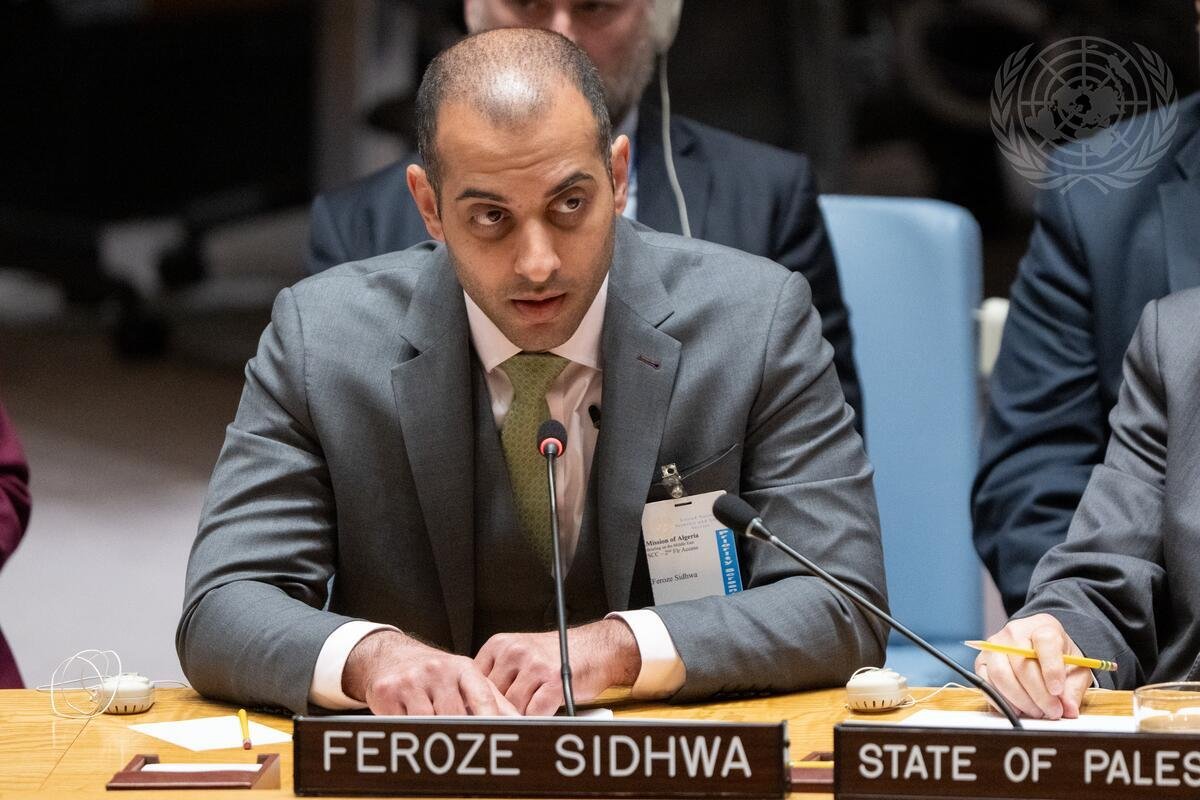
Dr. Feroze Sidhwa testifying to the U.N. Security Council on Gaza, May 2025.
Dr. Feroze Sidhwa testifying to the U.N. Security Council on Gaza,
May 2025.
What the Surgeon Saw
Ask Dr. Feroze Sidhwa what he hopes people will remember about him. “I guess that means when I’m dead,” he says. “I have no idea. I don’t know.” Coming from someone who has seen Hell on Earth, his answer is in character.
Dr. Sidhwa, a triple-board certified surgeon based in California, has become one of the most visible medical witnesses to the destruction of Gaza’s entire medical system and the targeting of its children. When he isn’t abroad, he practices at San Joaquin General Hospital in Stockton, the only trauma center for roughly a million people in San Joaquin County.
Since October 2023, he has completed two medical missions in Khan Younis, a city in the southern Gaza Strip. The first was two weeks at the European Gaza Hospital trauma center, beginning March 25, 2024. The second was four weeks in the trauma bay at the Nasser Medical Complex the following spring, from March 3 to April 1, 2025, with the American NGO MedGlobal. He set out to return a third time, leaving with MedGlobal on November 10, 2025, but Israel turned him back at the border. Beyond Palestine, his humanitarian work has taken him to Ukraine, Zimbabwe, the Dominican Republic, Haiti, Burkina Faso, and Ethiopia.
He is also one of three physicians featured in American Doctor, Poh Si Teng’s 2026 documentary about Americans who volunteered in Gaza’s hospitals and refused to stay silent once they came home. The film pairs Dr. Sidhwa with Dr. Mark Perlmutter, a Jewish orthopedic surgeon from North Carolina, and Dr. Thaer Ahmad, a Palestinian American emergency physician from Chicago.
Their differences are the point rather than a dividing line: one is Jewish, one Palestinian, one Zoroastrian. They carry the same passport and humanitarian calling, and confront devastation head-on.
An agnostic Zoroastrian by his own description, Dr. Sidhwa offers a relatable middle ground in the film. Where Dr. Ahmad brings personal investment and Dr. Perlmutter a sense of personal obligation, Dr. Sidhwa bridges his colleagues’ driving forces with basic logic. As an American, he refuses to accept that his country’s taxpayers should fund genocide. On-screen, he is a warm presence in blood-soaked wards. Young and old alike are glad to see him despite the nightmarish circumstances. Most of the film’s lighter moments center on him. After escaping certain death via missile, we watch him return to his duties, shrugging off his near-annihilation. He has work to do.
Ask Dr. Sidhwa about his best moments with his fellow doctors, and, again, he steers away from himself. What he remembers are “the human moments,” like a hand placed on a shoulder when someone’s voice began to shake. He and his two colleagues live far apart and rarely see one another, he notes, yet the bond is real and not unique to them. “It’s pretty much everybody who’s been to Gaza,” he says. “We all kind of function the same way.”
What he experienced in Khan Younis is riddled with blood, filth, deprivation, and death. Thousands of displaced Palestinians sheltered on the hospital grounds while they waited for care. The sewage system beneath the ground floor, where many of them slept, backed up every few days and flooded the radiology department with feces. Families cooked pita on hot plates in the emergency department as mass casualties poured in around them. Small children would wander over to look at and even touch open wounds while he cut away dead tissue.
Within his first forty-eight hours at the European Gaza Hospital, he treated four boys under the age of ten, each with a nearly identical gunshot wound to the head. Over the next two weeks, nine more children arrived with the same injury. That pattern convinced him, and later dozens of his colleagues, that the children were being shot deliberately. On his second mission, he says, the Israeli military bombed the Nasser complex with weapons made in America. Among his patients there was Jury, a girl of nine whose right arm and both legs had been broken and who was missing two inches of her left femur.
Despite claims to the contrary, Dr. Sidhwa insists he is not “obsessed with Palestine.” He says he has no particular connection to the place and would be perfectly happy never to return. What keeps him talking about Gaza, he says, is not the place but the money – specifically, American money.
“It’s not that I’m obsessed with Palestine,” he says. “I’m obsessed with not slaughtering people, and you should be too.”
His frustration is aimed at Americans who tell him they have no stake in any of it. He puts it simply: imagine walking into a gas station, paying someone there to shoot the clerk, and then claiming you have no relationship to what happened. Make that argument in a courtroom, he says, and you’d be sent somewhere other than prison. In his view, every American already has a connection to Gaza, whether they choose to see it or not. “You have your foot on their neck.”
Asked about books that might help someone understand the conflict, Dr. Sidhwa first says most people shouldn’t bother. Understanding the history of the conflict, he argues, is a separate question from understanding one’s own government’s role in it, and the second is the one that matters. He recommends Noam Chomsky’s The Fateful Triangle and steers people toward books on the American constitutional order rather than anything set in the Middle East. The gist is to learn how your own country works before worrying about anyone else’s.
That same conviction runs through an essay he helped write, Standing by Our Colleagues in Gaza: A Plea to the U.S. Medical Community. Its authors, who include Israeli and Jewish physicians, describe a striking asymmetry. When colleagues recounted treating victims of the October 7 attack in Israel, the American medical community met them with sympathy. When Dr. Sidhwa, along with some of those same colleagues, described what they had seen in Gaza, they were often met with suspicion or hostility. After he helped assemble a New York Times essay in which sixty-five American doctors, nurses, and paramedics described what they had witnessed, some physicians accused the witnesses of lying. One colleague told him, “Everything you saw there is the Palestinians’ own fault – they want their kids to die.”
The essay lays out the scale of the collapse using figures attributed to the United Nations, the World Health Organization, and Physicians for Human Rights Israel: more than 65,000 Palestinians killed, nearly 20,000 of them children; the great majority of Gaza’s hospitals damaged or destroyed; well over a thousand health workers killed and hundreds more jailed without charge; and life expectancy roughly halved. It closes with four demands the authors call the bare minimum under international law: unimpeded humanitarian access, a ceasefire to allow it, unrestricted entry for medical personnel and equipment, and the release of both detained medical workers and hostages held by either side.
Dr. Sidhwa is blunt about what he believes is happening. He calls it a campaign ordered from the top rather than the work of a few bad actors, and he dismisses the claim that tunnels beneath Gaza’s hospitals justify destroying them. Even if such tunnels existed, he says, hospitals everywhere, Israel’s included, have underground infrastructure – that is no reason to level them.
Asked what an orphaned Gazan child with no family left will face, he refuses to soften it: someone will likely take the child in, because that is the culture, “but nothing good will happen to them, that’s for sure.” Asked whether such children should be adopted abroad, he declines to rule on it at all. Who is he, he says, to tell a Palestinian family what to do with their own child, especially when an American bomb may have put them in that position? “Who the hell cares what I think about it? That’s just moral cretinism.”
His modesty comes with a deep faith in ordinary people. He rejects the premise that anyone is powerless: you are not “just an ordinary person,” he says, but “a citizen of the most powerful country that’s ever existed.” One voice accomplishes nothing, he concedes, but a neighborhood or a city is another matter. He has been urging people to get their city councils to pass resolutions, unglamorous as that sounds, because that is where an individual actually has leverage.
He practices what he preaches, and he does it without a fee. He travels worldwide to speak about Gaza and never charges for his insight. It fits a man who keeps insisting that the attention belongs on the cause, never on himself.
Despite everything he has seen, Dr. Sidhwa is far from a grim figure. “I’m not a joyless person at all,” he says. When it is time to be serious he is serious, and when it isn’t, he is happy. Plenty still makes him laugh. Asked what might surprise people about him, he offers that he holds a green belt with a black stripe in Krav Maga, which, he admits, does tend to catch people off guard. Asked what he most wants to do on returning from a war zone, he keeps it simple: take a shower and go to sleep.
If he weren’t a trauma surgeon, he says, he’d probably have become a professor of Arab-Israeli history, though he figures he’d have been fired by now, “so I’d probably be a taxi driver.”
It’s a joke, but it lands the way his deflections tend to – it turns the conversation back to the thing he actually cares about.

(L–R) Dr. Thaer Ahmad, Poh Si Teng, Dr. Feroze Sidhwa, and Dr. Mark Perlmutter at the premiere of ‘American Doctor’,
August 2026.
Chatting with Dr. Feroze Sidhwa
This interview has been edited for length and clarity.
The Israeli military has released 3D animations that supposedly show Hamas tunnels beneath hospitals, including Nasser. You were inside that hospital and have publicly doubted the footage. What are they trying to justify with 'evidence' like this, and who is it really made for?
You put ‘evidence’ in quotation marks, because it isn’t evidence. These 3D animations of what the Israelis claim – I don’t even think they believe these things are under the hospitals. But whether the tunnels under hospitals exist or not is actually beside the point, and I think this is one of the major achievements of Israeli propaganda – actually, I should say our and Israeli propaganda.
When you frame it as a yes/no question -“are there tunnels under these hospitals or not,” maybe with some gray area we can argue about – the more important question gets lost. So let’s just pretend there are tunnels under the hospitals. In fact, let’s pretend all of Gaza is one gigantic tunnel network – which, even at the size the Israelis claim, is completely ludicrous, but let’s pretend it’s all true. Who cares? In what sense can the Palestinians not build tunnels under their own hospitals? It doesn’t make any sense. Every major Israeli hospital has an underground component, and there’s a good reason for it: Israel is a country that’s usually at war, so you want to be able to move patients into a secure area.
With the Palestinians it might be used for other reasons, who knows. But whether or not there are tunnels under Gaza’s hospitals is completely irrelevant to the question of whether Gaza’s hospitals should be physically destroyed. If that logic held, then most American hospitals should be destroyed by Iran, since we’re attacking them, and most Israeli hospitals should be bombed by Hamas or Hezbollah or Iran, since Israel is attacking all of them.
It’s just silly. We fall into the propaganda trap when we argue about the tunnels themselves. That’s leaving aside that, as you’re correctly implying, these tunnels mostly don’t exist.
Some of what you saw goes past the brutality of war into something colder and more deliberate. Where does that viciousness come from, and how much of it felt like individual cruelty versus something taught and systematic?
It’s hard to comment on that as a physician who worked in the hospital – I just see the patients and take care of them. But there’s a lot of literature on this, most of it by Israelis, and there’s no question that Israeli society has been moved, shockingly, over to the fanatically religious and chauvinist right. Today it’s almost unrecognizable even from when I lived there in 2004 and 2005 – it’s gone completely off the rails.
Just a few days ago, the New York Times ran an entire article basically quoting ex-Israeli generals about what the settlers are doing in the West Bank, which is a small pittance of what’s being done in Gaza. Moshe Ya’alon, the former army chief of staff – himself an extremely corrupt, venal, ultra-racist guy – even he finds this too much. Quoting him from the Times article: “What is Jewish supremacy? The master race is now us.” That’s a shocking thing for an Israeli ex–army chief of staff to say publicly.
So, it’s pretty clear this is taught and systematic. There are certainly individual lunatics in the Israeli army who just like hurting people, no question, but the vast majority of the destruction of Gaza was ordered. Crazy pilots who are murderous psychopaths don’t get to take off whenever they want and drop bombs whenever they want; that’s not how the air force works. This is a top-down, ordered genocide. That’s perfectly clear.
Another good example: the recent announcement, made with great fanfare in the American media, that Israel was going to investigate the killing of Hind Rajab. Who cares? It was ridiculous. The people responsible for killing Hind Rajab are Benjamin Netanyahu and Bezalel Smotrich and Israel Katz and Yoav Gallant, and on our side, Joe Biden and Brett McGurk and Antony Blinken and Lloyd Austin and Jake Sullivan. Maybe some tank gunner fired his weapon inappropriately, sure – but why was he there in the first place? Why did he already have it in his mind that Arab children don’t deserve to live? It’s not hard to find the answer to that.
You've been blunt that American tax dollars pay for this genocide. What do you most want an American who has never thought about Gaza to understand about their own connection to it?
When people ask why I’m so “pro-Palestine” or so “obsessed” with Palestine, I explain that I’m not. I’d actually be very happy never to go back to the Palestinian territories again. I’m in Ethiopia right now. I have no particular connection to Palestine. The reason I’m connected to it is that my government forces me to be: it takes my tax dollars and uses them to subsidize the mass murder of children in Gaza, the destruction of an entire society in Gaza and the West Bank – the destruction of an entire national group. It’s not that I’m obsessed with Palestine; it’s that I’m obsessed with not slaughtering people, and you should be too. Every American should be. Most Americans don’t want to be involved in this – that’s why it has to be hidden from them.
None of us, unless you’re a Palestinian American, has a connection to Palestine. But imagine I walked into a gas station and paid someone there to shoot the clerk. Could I possibly say, “Well, I don’t have any relationship to this gas station, why do I care what happens here”? It’s outrageous. Make that argument in court and you might be put in an insane asylum instead of prison.
It’s bizarre when people say, “I don’t care about Gaza because I don’t have any connection to Palestine.” Yes, you do. You have your foot on their neck. You might not choose to see it that way, but that’s obviously the case. Imagine a German who said, “I don’t have any connection to Poland,” or “I don’t have any connection to Jews, so why do I care what happens to them?” It’s pure moral lunacy.
People feel more powerless than ever. What can an ordinary person actually do that won't just fall on the deaf ears of their congressman?
First, realize you’re not just an ordinary person – you’re a citizen of the most powerful country that’s ever existed. You asked what an ordinary person can do that won’t fall on a congressman’s deaf ears. Well, nothing, but that’s not the point. The people elected to Congress are basically exactly who you don’t want running a country: obsequious, in love with power and privilege, able to convince themselves of anything you tell them. A few exceptions aside, they’re ridiculous people. On Gaza, Palestine, ICE, Medicare for All – it’s not that they want to slaughter children; I doubt most of them do. Randy Fine might be an exception, or Ted Cruz, but the vast majority don’t actually want to be involved in these things. They’ve just convinced themselves it’s fine if they are “and in any case, we’re not doing it, so it doesn’t matter.” That’s how they think themselves into it.
So the job isn’t to convince our congresspeople of anything. They don’t have principles; they can’t be convinced one way or the other. What they need to understand is that they’ll pay a political price for not doing the right thing. And that means you, as an ordinary person, have to get organized – because you’re right: one voice doesn’t matter, two voices don’t matter, but a whole city, a whole neighborhood, is a different matter.
That’s why I keep telling people that one of the main things they can do, and everyone feels it’s silly, because it kind of feels that way, is get their city councils to pass resolutions. You have far more influence at that level. Plenty of city councils have passed resolutions condemning aid to Israel and calling for it to stop; it’s not covered in the press, but plenty have. That’s not a small effort. It might take a year or two, but if you’d started two years ago, you’d be done by now.
So, start now. Talk to your neighbors, talk to people. You can’t do these things in isolation; they have to be organized and done together.
Thousands of Gazan children have been orphaned or torn from their families. What happens to a child who survives but has no one left?
It’s not an easy question to answer. Gaza is a very, very small place. Everybody knows everybody else.
Someone will try to take care of that child, almost certainly – it’s just the culture. But nothing good will happen to them, that’s for sure.
Some have proposed relocating orphaned Gazan children abroad through international adoption, especially those with no surviving relatives. Where do you land? Is it ever the right answer, or does it risk becoming part of the erasure? If not adoption abroad, what is the realistic path for a child with no family and no system left around them?
I can’t really comment on that. I can’t tell a Palestinian family in Gaza that wants their child to go abroad, “Oh, you’re abandoning your home.” Who the hell am I to tell them that? Maybe if I hadn’t dropped the bombs on them, they wouldn’t be in that situation. So, who cares what I think about it? That’s just moral cretinism.
But one thing your question implies is that Gaza is its own country, and it’s not. Almost everybody in Gaza has family in the West Bank, yet the Israeli courts have ruled that even children cannot be allowed to go from Gaza to the West Bank. That’s another easy thing Americans could raise: we could tell our congresspeople, look, if Israel won’t let orphaned five-year-olds go to the West Bank, what kind of ally is this? How is that in any way reasonable?
Your stacks of books seen in the film mark you as a serious reader. If someone wanted to truly understand this conflict, what are some recommended reads?
Before I answer: you do not need to understand the Israeli-Palestinian conflict to understand our role in it. Those are different questions.
The nuances of the conflict are somewhat interesting historically. There are hundreds, if not thousands, of PhDs on the topic, but what you have to understand is what we’re doing: subsidizing the mass murder of children and the destruction of an entire society. Is that something you want to be involved in or not? That has nothing to do with how the Balfour Declaration came about, or what the Peel Commission report said, or the exact date the 1967 war started, or why Nasser closed the straits. None of it changes the fact that you’re not supposed to subsidize the mass murder of children. It’s very simple. I got interested in the conflict in college and have read a lot about it and still do – but for most people it’s a total waste of time.
Instead, learn about your own society, American society. For that, the most important book I’ve ever read is The Framers’ Coup by Michael Klarman. It’s not new. It’s the only academic book I know on the framing and passage of the US Constitution, and it’s fascinating, because what you discover is that the Constitution is essentially a radically anti-democratic document. I won’t go into the details, it’s a long story, but it’s very worth reading. Once you’ve read it, the answer to your congressman question becomes obvious: it doesn’t matter, because your congressman exists to stop you from making change in your society. That’s literally true. It’s a far better use of most Americans’ time than reading about Israel-Palestine because Israel-Palestine isn’t the only thing we’re doing wrong in the world, or even at home.
Our government is completely out of control right now; it’s gone crazy, and that’s tied to the fact that Americans don’t recognize what their own government is or how it needs to change. Gaza, Iran – I’m in northern Ethiopia right now, in Tigray, where we’re helping fund the destruction of this place – it all goes back to the same problem. Americans don’t actually run our own country, and it was set up that way on purpose. We’ve been chipping away at that anti-democratic system for a long time, but we haven’t gotten there yet. If we don’t soon, we might end up destroying the world.
That said, if someone does want to understand the conflict itself, the best book to start with is still Noam Chomsky’s Fateful Triangle. The subtitle – The United States, Israel, and the Palestinians – is exactly right, because it looks at the US’s role first and foremost. It was written in 1983 and last updated around 2006; Chomsky had a bad stroke, so unfortunately he’ll never update it again.
After that, Norman Finkelstein has written a series of books, some of which I’ve edited, and which you saw in that stack in the film – all quite good and useful. The two most useful for the history: Image and Reality of the Israel-Palestine Conflict, still very worth reading; and Beyond Chutzpah, the first of his books I helped edit. Finally, there’s his 2017 or 2018 book, which I wasn’t involved in, Gaza: An Inquest into Its Martyrdom. It brings you almost to the present, though not literally to October 2023.
There are plenty of others: for something more academic, the work of a professor named Mark Tessler; and many of Benny Morris’s works are worth reading, even though he’s a right-wing Israeli fascist. Israel-Palestine is probably the most studied conflict in history other than World War II, so there’s no shortage of material. But for me, reading Chomsky’s Fateful Triangle gives any American the right mindset for the conflict – which is: what is our involvement in it?
Coming home from a war zone, what is the first ordinary thing you want to do? What unremarkable thing did you miss most while you were away?
Honestly, we spend such short stretches in these places – I don’t mean to make fun of anyone, but I’ve never understood how people say “I miss this” or “I can’t do without that for three weeks.” I just don’t get the concept of missing something for two or three weeks. If there’s any creature comfort you can’t give up for that long, maybe you shouldn’t go to such places. But I’ll tell you the first ordinary thing you want to do: just take a shower and go to sleep.
What are some of your favorite moments with Dr. Perlmutter and Dr. Ahmad?
My favorite moments with Mark and Thayer are the human ones. We’ve all put a hand on each other’s shoulder at some point, because we heard a quiver in a voice or saw a little shake, and we knew that person needed support. Mark, Thayer, and I actually spend very little time together, since we live so far apart – but there’s that bond. It’s not just the three of us; it’s pretty much everybody who’s been to Gaza. We all function the same way.
What is something people would be surprised to learn about you?
I have no idea. I have a green belt with a black stripe in Krav Maga. That does surprise most people, to be fair.
If you weren't a trauma surgeon, what would you be?
Probably a professor of Arab-Israeli history, except I’d have been fired by now, so probably a taxi driver.
What still makes you laugh, no matter what?
Lots of things make me laugh. It maybe comes across otherwise in the film, but I’m not a joyless person at all. When it’s time to talk about serious stuff, I’m serious; when it’s not, I’m happy.
What restores you when you feel hollowed out?
I say all the time that my work abroad recharges my moral batteries. I like the work I do at home too, but abroad it’s a different thing – it’s medicine and helping your fellow person in its purest form. It’s wonderful.
What could you talk about for an hour straight that has nothing to do with your work?
Nothing, unfortunately – for me and everyone who’s ever tried to date me.
Beyond the work, what do you hope people remember about you?
I guess that means when I’m dead – I have no idea. I don’t know.